How Long Does It Take a Child to Become Bilingual?
An app promises fluent in three months. A bilingual-from-birth comparison suggests it might never happen. Neither is the real answer.
Section 01The Short Answer
There’s no single answer to how long it takes a child to become bilingual, because bilingual isn’t one finish line. A child can hold a real conversation in French or Spanish within a year or two of consistent weekly lessons and some practice outside them. Reaching the reading and writing level a school expects in that language takes meaningfully longer. Researchers split this into two measurable stages, and the gap between them is bigger than most parents expect walking in.
The most useful framework here comes from Jim Cummins, a psychologist who studied immigrant children in Toronto schools starting in the late 1970s. He found kids picked up everyday conversational skills in about two years. Academic-level proficiency, the kind needed to keep up with a classroom actually taught in that language, took five to seven years on average. That gap between sounds fluent and is at grade level is the most useful number in this entire topic, and it’s the one most timelines skip past.
- Conversational comfort, real back-and-forth and following a simple story, tends to show up within about 1 to 2 years of consistent weekly lessons plus some practice outside them.
- Academic-level proficiency, keeping up with grade-level schoolwork taught in that language, takes considerably longer: 5 to 7 years is the range researchers studying immigrant and immersion students actually found.
- Those numbers assume heavy exposure: a full school day taught in the language, or a move to a new country. A once-a-week lesson moves slower without added practice, and no study has measured that exact pace.
- Reading and writing at grade level is part of the slower academic stage, not a separate finish line. It doesn’t arrive before conversational comfort does.
Section 02Why parents want one clean number
Parents ask this question wanting a date to circle on a calendar, and that’s a fair thing to want when you’re deciding whether lessons are actually working. Two comparisons usually trigger it, and neither measures what you think it measures.
A language app ad promises fluency in three months. A cousin who grew up in a two-language household never seems to search for a word. The app’s three-month claim usually means something closer to ordering a coffee and asking for directions: a real skill, just not what most parents picture when they say bilingual. The cousin didn’t learn on a weekly-lesson schedule either; both languages ran in the background of daily life from birth, a different starting condition than a child adding French or Spanish at school age.
There’s a third, quieter trigger: a school progress note that says your child is “making good progress” without saying toward what. That’s not wrong. It’s just using a scale most parents were never shown (Section 05 covers what that scale actually looks like).
Apps aren’t a waste of time here. An app like Duolingo can be a fine habit-builder alongside real lessons. It’s the marketing claim attached to it, not the tool itself, that sets the wrong expectation.
Section 03The research, actually checked
The clearest framework for this question isn’t a marketing number. It’s a distinction Jim Cummins proposed decades ago, and it still holds up under a citation check today.
Cummins called the first kind BICS, Basic Interpersonal Communicative Skills: the everyday language of a hallway conversation or a video call with a grandparent. He called the second CALP, Cognitive Academic Language Proficiency: the language of a textbook or a word problem, the kind a child needs to actually learn new material in that language rather than just chat in it. In his reanalysis of Toronto Board of Education data on immigrant students, conversational fluency showed up in about two years. Academic proficiency, catching up to grade-level peers on the language skills school actually tests, took five to seven years on average.
A separate study out of Stanford, led by Kenji Hakuta, tracked English learners across four school districts, two in California and two in Canada, chosen because they were considered strong programs. Even there, oral proficiency took three to five years, and academic English proficiency took four to seven. Strong programs, not weak ones. Earlier estimates the Hakuta team cited put the number as high as ten years for a child to be fully competitive with native-speaking peers across all academic language use. A third line of research, from Virginia Collier, found that without any support in a child’s stronger language along the way, academic proficiency stretched to seven years or more.
Three separate research efforts, run across two countries and three decades, landed on the same basic shape: conversational comfort within roughly two years, academic-level proficiency taking two to three times longer. That’s the kind of agreement that makes a framework worth using instead of a single average pulled from nowhere.
| Milestone | What it actually looks like | Research timeframe | Source |
|---|---|---|---|
| Conversational fluency (BICS) | Everyday back-and-forth: ordering food, a video call with family, following a simple story out loud | About 2 years of consistent, heavy exposure | Cummins (1981), Toronto Board of Education data |
| Academic proficiency (CALP), including reading & writing | Keeping up with grade-level schoolwork taught in that language: written paragraphs and real class discussion | 5–7 years, even in strong programs | Cummins; Hakuta, Butler & Witt (Stanford/UC, 2000) |
| Academic proficiency, no first-language support | Same as above, with no reinforcement in the child’s stronger language along the way | 7+ years | Collier (1995) |
| Full parity with native-speaking peers | Fully competitive across all academic language use, not just keeping pace | Up to 10 years in earlier estimates | Cited in Hakuta, Butler & Witt (2000) |
Section 04The honest limitation nobody puts in the headline
Here’s the catch with every number in Section 03: researchers measured children with far more exposure than a weekly lesson gives them.
The studies above followed kids in full immersion school programs, or newly arrived in a country and schooled largely in their second language, most of the school week. That’s a different exposure rate than one hour of tutoring plus homework. If your child’s only contact with French or Spanish is a single weekly lesson, expect the conversational stage to take longer than two years unless something else fills the gaps, like daily reading or a relative to actually talk to.
We looked for a study measuring the timeline at once-a-week lesson pace specifically. We couldn’t find one, so we won’t invent a number for it here. What we can say honestly is the direction: less exposure stretches the timeline, and more exposure, without necessarily reaching full immersion, compresses it back toward the research numbers above. There’s also a structural difference worth naming. The children in these studies were learning their second language as the language of school itself. Most Inspire families are adding French or Spanish as a second subject while schooling continues in English, a genuinely different situation than the one Cummins or Hakuta measured, not a smaller version of the same thing.
Section 05What each milestone actually looks like
Numbers on a chart don’t tell you what to expect at pickup, so here’s what each stage actually sounds like in a real kid.
The earliest stage often looks like nothing at all, which worries parents more than it should. A child can understand far more than they say, nodding along to a story or following an instruction in French while still answering back in English. Teachers sometimes call this a silent period, and it’s a normal part of absorbing a new language, not a sign the lessons aren’t working. A child who understands French but won’t speak it yet is usually further along than the silence suggests.
Next comes scripted exchange: greetings and familiar classroom phrases, the kind of memorized description of the weather or a favorite food that sounds impressive to a parent who doesn’t speak the language. It feels shakier to the child than it sounds to you, because most of it is recall, not yet real-time sentence-building.
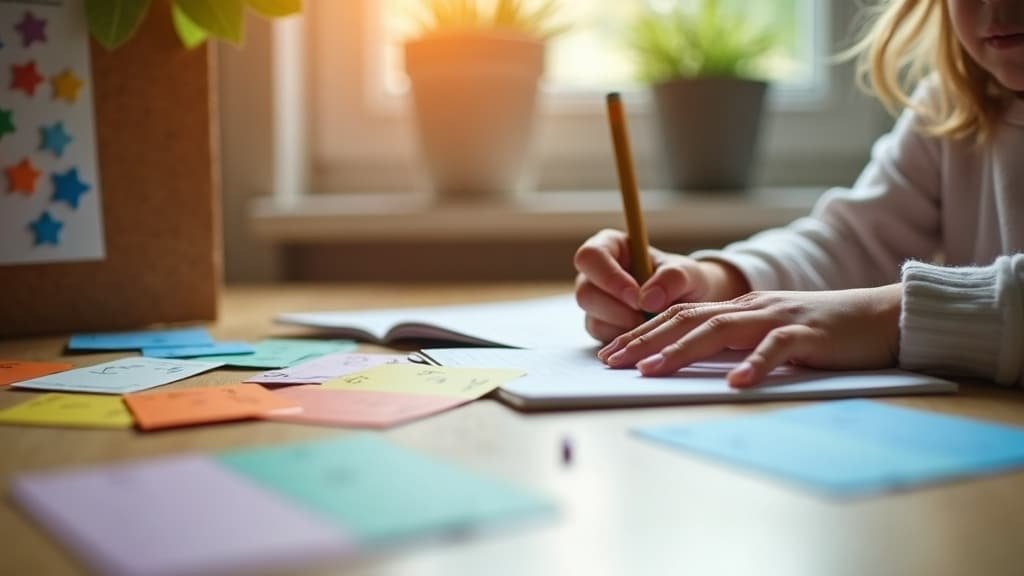
Conversational fluency isn’t when a child stops making mistakes. It’s when they keep talking through one instead of switching back to English.
Conversational fluency, the BICS stage, is different: a child can follow an unscripted question and push through a mistake without abandoning the sentence, telling you what actually happened at school instead of a rehearsed line. This is the stage most families actually mean when they say their child is bilingual, and it’s a genuinely achievable goal within a year or two of consistent lessons.
The academic stage, CALP, is where a level scale becomes useful instead of a feeling. CEFR levels, the same A1-to-C2 scale DELF exams use, give a concrete way to track this instead of guessing: a child moving from A1 to A2 is building the vocabulary and grammar base, and reaching B1 generally lines up with being able to follow a class discussion and write a short structured paragraph, roughly where CALP-level schoolwork starts to feel manageable rather than translated word by word.
Section 06What actually speeds this up
A few things move a child through these stages faster than the calendar alone would predict, and starting age isn’t one of them.
The first is exposure outside the lesson itself. A child getting one hour a week and nothing else will move slower than the research in Section 03. A child adding daily reading or a family member to actually talk to closes that gap fast. Families with one French-speaking parent see this directly: the exposure happening around the lesson, not just during it, is doing real work.
The second is real back-and-forth speaking practice, not passive listening. A show builds comprehension. It doesn’t build the muscle of constructing a sentence under time pressure and getting it corrected on the spot, which is what actually produces conversational fluency. That’s the real gap between an app streak and a weekly lesson with an actual teacher: nothing on the other end of a streak asks a follow-up question or catches a mistake before it turns into a habit.
Consistency beats intensity, too. A once-a-week lesson kept up for two full school years gets a child further than an intense summer camp followed by ten quiet months, because every study in Section 03 assumed sustained exposure, not sporadic bursts.
Section 07What to do this year
Section 08The verdict
Bilingual isn’t a date on a calendar. It’s at least two separate, measurable checkpoints, and the honest research says respect the gap between them: conversational comfort within roughly one to two years of consistent lessons and some outside practice, academic-level command of the language taking several years more, even in the strongest immersion programs researchers have studied. Anyone promising a faster universal number is rounding off a distinction that actually matters. The thing worth tracking isn’t a countdown. It’s whether your child is speaking more this month than last.
Section 09FAQ
How long does it take a child to become bilingual?
There’s no single number, because bilingual covers at least two different skills. Conversational comfort in everyday situations tends to show up within about two years of consistent, heavy exposure, based on research on immigrant and immersion students. Academic-level proficiency, the kind needed to keep up with schoolwork taught in that language, takes five to seven years on average under those same research conditions, which involve far more exposure than a weekly lesson provides.
What’s the difference between conversational fluency and being truly bilingual?
Researchers call these BICS (Basic Interpersonal Communicative Skills) and CALP (Cognitive Academic Language Proficiency). BICS is the everyday language of conversation: ordering food, chatting with a friend. CALP is the academic language of a classroom: reading a textbook and writing a structured paragraph. A child can sound conversational years before reaching grade-level academic proficiency in that language.
Can weekly French or Spanish tutoring actually get my child to conversational fluency?
Yes, but expect it to take longer than the two-year research benchmark unless practice happens between lessons too. Those numbers come from children with immersion-level exposure: a full school day taught in the second language, or a move to a new country. A weekly lesson plus reading or conversation at home closes that gap. A lesson with nothing else around it moves more slowly.
Does starting a language later mean it takes longer to become bilingual?
Starting age matters less than most parents assume. Studies comparing starting ages have found older child starters often move through grammar faster than younger starters, hour for hour. What actually predicts the total timeline is consistency and real speaking practice, not the age a child started.
What’s a realistic first-year goal for a child starting French or Spanish lessons?
A realistic first-year goal with consistent weekly lessons is basic conversational comfort: greetings and familiar back-and-forth, not fluency. Full conversational ease tends to take closer to two years, and academic-level proficiency takes considerably longer than that.
Does reading and writing take longer than speaking to develop?
Yes. Literacy and academic language are part of what researchers call CALP, the slower-developing side of bilingual proficiency, and they trail conversational speech by a meaningful stretch, generally several years. The same pattern shows up in first-language literacy development, not just a second language.
How long does it take a child to become bilingual?
There’s no single number, because bilingual covers at least two different skills. Conversational comfort in everyday situations tends to show up within about two years of consistent, heavy exposure, based on research on immigrant and immersion students. Academic-level proficiency, the kind needed to keep up with schoolwork taught in that language, takes five to seven years on average under those same research conditions, which involve far more exposure than a weekly lesson provides.
What’s the difference between conversational fluency and being truly bilingual?
Researchers call these BICS (Basic Interpersonal Communicative Skills) and CALP (Cognitive Academic Language Proficiency). BICS is the everyday language of conversation: ordering food, chatting with a friend. CALP is the academic language of a classroom: reading a textbook and writing a structured paragraph. A child can sound conversational years before reaching grade-level academic proficiency in that language.
Can weekly French or Spanish tutoring actually get my child to conversational fluency?
Yes, but expect it to take longer than the two-year research benchmark unless practice happens between lessons too. Those numbers come from children with immersion-level exposure: a full school day taught in the second language, or a move to a new country. A weekly lesson plus reading or conversation at home closes that gap. A lesson with nothing else around it moves more slowly.
Does starting a language later mean it takes longer to become bilingual?
Starting age matters less than most parents assume. Studies comparing starting ages have found older child starters often move through grammar faster than younger starters, hour for hour. What actually predicts the total timeline is consistency and real speaking practice, not the age a child started.
What’s a realistic first-year goal for a child starting French or Spanish lessons?
A realistic first-year goal with consistent weekly lessons is basic conversational comfort: greetings and familiar back-and-forth, not fluency. Full conversational ease tends to take closer to two years, and academic-level proficiency takes considerably longer than that.
Does reading and writing take longer than speaking to develop?
Yes. Literacy and academic language are part of what researchers call CALP, the slower-developing side of bilingual proficiency, and they trail conversational speech by a meaningful stretch, generally several years. The same pattern shows up in first-language literacy development, not just a second language.
Find out your child’s real starting level
One of Inspire’s certified teachers assesses comprehension, vocabulary and speaking in a focused 30-minute session, then sends you a written level report within 48 hours.
Have a question first? Contact us →
 French
Is My 8-, 9- or 10-Year-Old Too Old to Start French or Spanish?
Your child’s friends started French immersion in kindergarten, or you read somewhere that the “window” closes early. Here’s what happens when a child…
 Guide
GuideFrench CEFR Levels for Kids (A1 to B1) Explained for Homeschool Parents
French CEFR levels for kids explain what A1, A2 and B1 actually look like during a lesson — so you can place your child and track real progress without…
 Guide
GuideMy Child Understands French but Won’t Speak: Why This Is Normal
If your child understands French but won’t speak, this is completely normal and often part of the natural “Silent Period” described in the ACTFL…
About Inspire Tutors
Inspire Tutors has guided families toward real bilingual progress since 2012 — one certified teacher, the same weekly slot, tracking actual speaking gains instead of app streaks or grade-level labels.
See how a 30-minute assessment works →- Cummins, J. (1981). The role of primary language development in promoting educational success for language minority students. In Schooling and Language Minority Students: A Theoretical Framework. California State Department of Education.
- Hakuta, K., Butler, Y.G., & Witt, D. (2000). How Long Does It Take English Learners to Attain Proficiency? University of California Linguistic Minority Research Institute, Policy Report 2000-1.
- Collier, V.P. (1995). Acquiring a second language for school. Directions in Language and Education, 1(4). National Clearinghouse for Bilingual Education.